It's OK Not to Know Everything
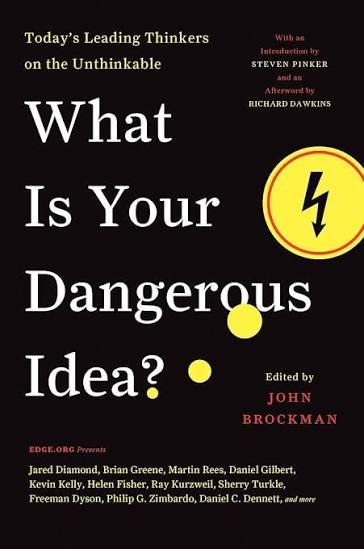
Essay written by Marcelo Gleiser. Originally published in the book What Is Your Dangerous Idea?: Today’s Leading Thinkers on the Unthinkable, Volume 4 de Edge Question Series, 2007.
The world's leading scientific thinkers explore bold, remarkable, perilous ideas that could change our lives—for better . . . or for worse . . .
From Copernicus to Darwin, to current-day thinkers, scientists have always promoted theories and unveiled discoveries that challenge everything society holds dear; ideas with both positive and dire consequences. Many thoughts that resonate today are dangerous not because they are assumed to be false, but because they might turn out to be true.
What do the world's leading scientists and thinkers consider to be their most dangerous idea? Through the leading online forum Edge (www.edge.org), the call went out, and this compelling and easily digestible volume collects the answers. From using medication to permanently alter our personalities to contemplating a universe in which we are utterly alone, to the idea that the universe might be fundamentally inexplicable, What Is Your Dangerous Idea? takes an unflinching look at the daring, breathtaking, sometimes terrifying thoughts that could forever alter our world and the way we live in it.
Can science explain itself?
There have been many times when I asked myself if we scientists, especially those seeking to answer "ultimate" kind of questions such as the origin of the Universe, are not beating on the wrong drum. Of course, by trying to answer such question as the origin of everything, we assume we can. We plow ahead, proposing tentative models that join general relativity and quantum mechanics and use knowledge from high energy physics to propose models where the universe pops out of nothing, no energy required, due to a random quantum fluctuation. To this, we tag along the randomness of fundamental constants, saying that their values are the way they are due to an accident: other universes may well have other values of the charge and mass of the electron and thus completely different properties. So, our universe becomes this very special place where things "conspire" to produce galaxies, stars, planets, and life.
What if this is all bogus? What if we look at sciece as a narrative, a description of the world that has limitations based on its structure? The constants of Nature are the letters of the alphabet, the laws are the grammar rules and we build these descriptions through the guiding hand of the so-called scientific method. Period. To say things are this way because otherwise we wouldn't be here to ask the question is to miss the point altogether: things are this way because this is the story we humans tell based on the way we see the world and explain it.
If we take this to the extreme, it means that we will never be able to answer the question of the origin of the Universe, since it implicitly assumes that science can explain itself. We can build any cool and creative models we want using any marriage of quantum mechanics and relativity, but we still won't understand why these laws and not others. In sense, this means that our science is our science and not something universally true as many believe it is. This is not bad at all, given what we can do with it, but it does place limits on knowledge. Which may also not be a bad thing as well. It's OK not to know everything, it doesn't make science weaker. Only more human.