Kepler in the Dock
Book review of “Heavenly Intrigue”
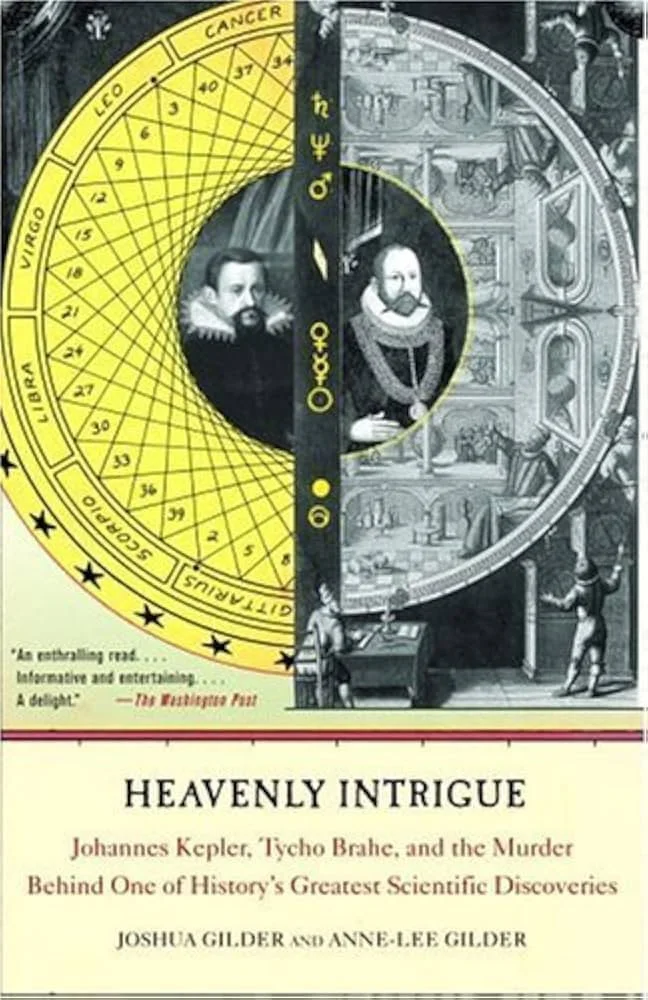
Heavenly Intrigue: Johannes Kepler, Tycho Brahe, and the Murder Behind One of History's Greatest Scientific Discoveries. Joshua Gilder and Anne-Lee Gilder (Doubleday, New York, 2004). Pp. xvi + 304. $24.95. ISBN 0-385-50844-1.
Originally published in Journal for the History of Astronomy, November 2004
As the title of this well-written book suggests, the "intrigue" here refers to Kepler, Tycho, and murder. What one finds out by reading it is that the murderer is Kepler and the victim is Tycho. Or so contend Joshua and Anne-Lee Gilder, a husband-andwife team, he a former White House speechwriter and novelist, she an investigative reporter for German television. Shocked? So was I, when I first put my hands on the book. Could Kepler, the man who first dared to introduce physics to astronomy, who devised the famous three laws of planetary motion that bear his name, actually resort to murder to achieve his ambitious goal of deciphering God's plan for the cosmos? Is this the same Kepler who compared himself to a "lapdog", who suffered terrible physical ailments and emotional losses throughout his life, who was excommunicated from the Lutheran Church for his attempts at reconciling quarrelling Christian faiths? Yes, say the Gilders, the very same.
There are many ways to tell a story, especially when all the characters are dead and none can come out to accuse or defend himself or others. In the absence of a smoking gun, the authors resort to forensic evidence. They claim that Tycho ingested a lethal dose of mercury thirteen hours before his death; and that the poison was coldly administered by a calculating, half-mad Kepler, bent on getting his hands on Tycho's astronomical data. There are thus three steps to the authors' claim: the large ingestion of an elixir laced with mercury; the fact that this substance was given to Tycho with the intent of murdering him; and the accusation of Kepler as the murderer. As I hope to show in the short space below, step one is believable, step two is doubtful, and step three verges on the preposterous.
The claim that Tycho ingested a large amount of mercury thirteen hours before his death is based on a study by Jan Pallon from Lund University in Sweden, an expert on a chemical method of analysis named particle-induced X-ray emission, or PIXE. In 1996, Pallon was given a sample of Tycho's moustache, recovered when his body was exhumed in 1901 from the Teyn Church in Prague. The beauty of the method is that it can give information of the chemicals ingested by the subject as a function of time, as they are carried by the blood flow and stored at different places in the body, including hair. Since hair grows at a known rate, one may look at different parts of a strand to deduce what substances were flowing in the subject's blood at different times. Pallon's data of Tycho's hair showed a clear spike in mercury about thirteen hours before he died. Note, however, that the analysis doesn't seem to give the amount of mercury ingested or whether that amount was lethal; only that there was a relative increase in the concentration of mercury at that time. Nevertheless, step one is established.
But not step two. Was Tycho murdered? It is not clear that he was, in spite of the authors' often compelling case-building. The authors spend quite some time colouring Tycho's personality, claiming he was a magnanimous man, honest to the bone, faithful to his friends, and incapable of self-harm. Kepler, on the other hand, was a dysfunctional person, frustrated and neurotic, capable only of acting self-servingly, possessed to the point of madness by his geometric ideal of cosmic order, which he had to prove at all costs. In one single page (189), the word 'deceit' (or 'deceive') appears three times, always relating to Kepler's machinations. I find both depictions very biased. There is plenty of evidence that Tycho was far from magnanimous, that he was a tremendously aggressive and, at points, an evil character, pretentious and tyrannical. Kepler was indeed a very complex person, of great emotional intensity and, true, very driven by his vision of cosmic order. But there is nothing whatsoever in Kepler's writings, or in his conduct toward Tycho or any other person, however angry and short-tempered, to suggest that he would be capable of murder. Yes, he desperately wanted Tycho's data. But that doesn't mean he could kill for it.
Just as an exercise in bias, one could tell this story in a completely different way. Tycho had been depressed due to his younger brother's death a year before. He had also been greatly distressed by disputations with Ursus, who falsely accused him of plagiarism. He was having serious financial difficulties. He knew, even though he couldn't accept, that his Earth-centred system of the world was wrong and that Copernicus was right. Before his death, he made sure the children from his common-law wife were his legal heirs and that Kepler had a sponsored position from Rudolph II. The night of his death, he "obtained the cessation of those sufferings from disease so that he might set very many things in order with great ease and reflection", wrote his eulogist, Dr Johannes Jessenius. "Thereafter, between prayers and exhortations, he said goodbye to us all." These actions could be interpreted as those of a man who was aware of his impending death. Was Tycho preparing his path to suicide? Did he wilfully drink the mercury? Or did an attending physician give it to him to alleviate his suffering? We will probably never know for sure. In the meantime, Kepler deserves to be left alone and to be celebrated for his magnificent achievements and resilience in the face of hardship.
© Science History Publications Ltd. • Provided by the NASA Astrophysics Data System